
This study guide reveals the name of Yahweh in the New Testament. It also includes key highlights regarding “the Lord” from previous posts.
- When Yahweh’s name is restored in both the Old and New Testaments, it becomes clear that the only way Messiah can be the Savior is if He is Yahweh.
- Consider John the Baptist’s declaration in Luke 3:4, “Prepare the way of Yahweh,” which identifies the Messiah as Yahweh.
Replacing the title of “the Lord” with the name “Yahweh” is a crucial key that enables us to correctly decipher His Scriptures.
God specifically intended for His personal name, Yahweh, to be known, spoken, and glorified.
Psalm 34:3 O magnify Yahweh with me and let us exalt his name together
Invoking the name of Yahweh is an act of faith and reliance on the God of our Salvation.
Romans 10:13 For whosoever shall call upon the name of Yahweh shall be saved
In Exodus 20:7, it is written, “Thou shalt not take the name of Yahweh thy God in vain.”
This commandment cautions against misusing or abusing the name of Yahweh, as well as using it in a false, deceptive, or profane manner (Ezekiel 36:20-23).
Replacing Yahweh’s name with a common human title diminishes His glory. It also represents a falsehood, as indicated in Isaiah 42:8. This deliberate act of omission or deception is clearly evident in key passages such as Mark 1:3, Luke 1:47, Romans 10:13, and Acts 2:21, where the proper name of Yahweh has been systematically removed, obscuring His identity as the only Savior.
Psalm 7:17 I will praise Yahweh according to his righteousness, and will sing praises to the name of Yahweh the most high
Praise the Name of Yahweh
Nowhere in the Scriptures is it suggested that we should avoid using Yahweh’s name out of reverence. In fact, the opposite holds true; we are called to praise and exalt His holy name. Moreover, as stated in Joel 2:32, those who call upon Yahweh will be saved.
Isaiah 25:1 O Yahweh, thou art my God; I will exalt thee, I will praise thy name; for thou hast done wonderful things; thy counsels of old are faithfulness and truth
The name of the God of the Old and New Testaments is transliterated from Hebrew into English as “Yahweh.”
Exodus 3:15 And God said moreover unto Moses, Thus shalt thou say unto the children of Israel, Yahweh, God of your fathers, the God of Abraham, the God of Isaac, and the God of Jacob, hath sent me unto you: this is my name for ever, and this is my memorial unto all generations.
The scribes showed utter contempt for the decree to call upon Yahweh—as evidenced in Isaiah 42:8—where they had the audacity to declare that His name is “the Lord.”
1 Chronicles 29:11 Thine, O Yahweh, is the greatness, and the power, and the glory, and the victory, and the majesty: for all that is in the heaven and in the earth is thine; thine is the kingdom, O Yahweh, and thou art exalted as head above all
Exodus 34:14 warns us: “Indeed, you shall worship no other god, for Yahweh, who is zealous for His name, is a jealous God.”
Yahweh’s name is not “the Lord”
“Lord” is a title that cannot replace the glorious name of Yahweh, regardless of religious traditions.
The name of Yahweh is translated as “the Lord” throughout the Old and New Testaments; this deception represents a purposeful transgression of Biblical proportions.
Words are translated, and proper names are transliterated.
Transliteration involves converting the sounds of a proper name from one writing system to another, while maintaining the original pronunciation.
Yahweh does not sound anything like the word “Lord.”
Yahweh’s name cannot be translated as Lord, God, Jehovah, or adonai, and there is no “J” sound or letter in the Hebrew language.
- The word “Kyrios” (Strong’s reference G2962) is translated as “Lord.” It has no etymological connection to the Hebrew name Yahweh, and it is derived from another Greek word, “kuros,” meaning “supremacy,” which is not even used in the Bible.
- It is essential to understand the implications of this deception that conceals Yahweh’s name in the New Testament.
- “Lord” is an Old English word that did not exist when our Savior walked the earth; it was developed many centuries later.
- “Kyrios” should be translated as “master,” not lord (see Matthew 6:24).
Both God and humans are referred to as “master” in the scriptures, but this title should never be used as a substitute for Yahweh’s name.
In the New Testament, the term “Lord” refers to both the Lord God and the Lord Jesus, and they are both addressed as “the Lord” (Mark 16:19; Jude 1:4)
Scriptural integrity is compromised when “the lord,” which is not a divine title, is used as a replacement for the name of Yahweh, and this same title is also used to refer to men, as evidenced in the following verse.
In Matthew 18:27, we read, “The lord (G2962) of that servant was moved with compassion.”
And in Mark 1:3, it is written, “Prepare ye the way of the Lord (G2962), make his paths straight.”
In Mark 1:3, John the Baptist is quoting Isaiah 40:3, which states,“Prepare the way of Yahweh (H3068); make straight in the desert a path for our God.”
John would announce the arrival of Yahweh, who manifest himself in the flesh as the Messiah.
Malachi 4:5 Behold, I will send you Elijah the prophet before the coming of the great and dreadful day of Yahweh
Compare Malachi 4:5 with Luke 1:17, and Matthew 17:10-13.
Consider also Luke 1:76, where Zacharias prophesies about his son John, “And thou, child, shalt be called the prophet of the Highest: for thou shalt go before the face of Yahweh to prepare his ways.”
The proclamation, ‘Blessed be Yahweh, the God of Israel,’ was an important expression of the covenant relationship between God and Israel (that King David used frequently), and it is found throughout the Old Testament (1 Samuel 25:32, Psalm 106:48, Psalm 41:13, 1 Kings 1:48, 1 Chronicles 29:10).
Zacharias also makes this prophecy in Luke 1:68, “Blessed be Yahweh, the God of Israel; for he shall visit and redeem his people.” Yahweh would indeed visit to redeem his people, in the person of the Messiah (John 1:19-27). One God revealed in one person.
Yahweh ‘shall visit’ to provide redemption for ‘all of’ his children.” This event had not yet occurred; hence, the words ‘shall visit’ in the future tense would be used in this passage.
The New Covenant Blessings are available to every individual in whom the spirit of Yahweh dwells; He shall be their God, and they shall be His people (Psalm 72:17-19, Genesis 12:3, 22:18, Galatians 3:8-9, Romans 8:14, Revelation 21:7). See also 2 Corinthians 6:16 and compare with Exodus 29:45, Revelation 21:3, Jeremiah 31:33.
2 Corinthians 6:18 And will be a Father unto you, and ye shall be my sons and daughters, saith Yahweh the Almighty
Revelation 1:8 I am Alpha and Omega, the beginning and the ending, saith Yahweh, which is, and which was, and which is to come, the Almighty
Refer to the section below entitled ‘Yahweh’s Name in the Old & New Testaments,’ He is the ‘First and the Last,’ the ‘Alpha and Omega.’
In Isaiah 45:21, Yahweh declared that there is no other God apart from Him. He alone is both God and Savior; there is none other besides Him.
There cannot be two Saviors who are both called God (Luke 1:47, John 20:28, Titus 2:13, Jude 1:25; 1 Tim 1:1).
Yahweh Revealed in the New Testament
- Mary called the Holy Child she gave birth to, Immanuel, a glorious title which is interpreted as “God with us.” Her Savior was also called the Messiah; He is the personification of Yahweh in the flesh (Isaiah 40:3, Matthew 1:23, 1 Timothy 3:16, Colossians 1:15-17).
- In Luke 1:46-47, Mary said: “My soul does magnify Yahweh, and my spirit has rejoiced in God my Savior.”
There are ninety-eight Bible passages throughout the Old and New Testaments—such as Joel 2:32, Acts 2:21, and Romans 10:13—where it is evident that “the name of the Lord” was inserted to replace “the name of Yahweh.”
In the four Gospels, “the name of the Lord” exclusively refers to the Messiah who comes in “the name of Yahweh.”
- After calling out the scribes and Pharisees for their hypocrisy in Matthew 23:1-38, Messiah quoted Psalm 118:26 and stated in Matthew 23:39, “For I say unto you, you shall not see me from now on until you say, ‘Blessed is he who comes in the name of Yahweh.’”
- As He descended from the Mount of Olives, a large crowd of His followers began to rejoice and praise God with loud voices for all the mighty works they had seen, saying, “Blessed is the King of Israel who comes in the name of Yahweh; peace in heaven, and glory in the highest” (Luke 19:37-38).
- In John 12:13, a similar joyful proclamation is recorded as the people cried out to their Messiah, “Hosanna! Blessed is the King of Israel who comes in the name of Yahweh.”
1 Timothy 3:16 And without controversy great is the mystery of godliness: God was manifest in the flesh, justified in the Spirit, seen of angels, preached unto the Gentiles, believed on in the world, received up into glory
If we were instructed to call upon the name of the Lord, identifying the one who holds that title would be important. The question would have to be asked, “What is the name of the Lord that saves us?”
For those who adhere to the doctrine of the trinity, the response to this question would be, “The name of the Lord is Jesus; He is the only Savior.”
But if you believe in the infallibility of the Scriptures, according to Isaiah 42:8, the name of “the Lord” is “the Lord.”
Unfortunately, the misleading translation of this verse in Isaiah indicates that the scriptures have been compromised.
Isaiah 42:8 is properly translated as: “I am Yahweh that is my name, and my glory shall you not give to another, neither give your praises to graven images”
Yahweh manifest as the Messiah
Messiah’s presence represents the manifestation of Yahweh’s essence in human form.
In the Old Testament, there is only one Savior. However, in the New Testament, the Father is recognized as one of two Saviors (Luke 1:47, 1 Timothy 1:1-2).
Even though our Messiah taught his disciples to pray with the words, “Our Father, who art in heaven, hallowed be thy name,” the name of the Father is not mentioned in the New Testament.
Yahweh’s Holy name has been concealed and replaced by the title of “the Lord.”
In John 8:42, He said, “I proceeded forth and came from God; neither came I of myself.” This declaration remains a parable for most preachers.
- The interpretation is clarified later in the same chapter with five powerful words: “Before Abraham was, I AM.” Existing eternally as Yahweh, He manifest Himself in the flesh; this represents one God revealed in one person (Exodus 3:13-15, John 14:7-9, 2 Corinthians 4:4, Colossians 1:15, and Hebrews 1:1-4).
In John 14:6, He presents another significant parable regarding His true identity: “I am the way, the truth, and the life; no man cometh unto the Father, but by me.”
The interpretation for this statement follows immediately in the next verse, where He says, “If you know me, then you know the Father. Indeed, from now on you know Him and have seen Him.”
Philip, not realizing that his Messiah is claiming to be the Father, says in John 14:8, “Master, show us the Father, and we will be satisfied.”
His response to Philip’s request, given in John 14:9, provides even more clarity: “He that has seen me has seen the Father. How then do you say, Show us the Father?”
The Father is glorified in the Son (John 14:13) because the Father dwells within the Son (John 14:10).
John 14:10 Believest thou not that I am in the Father, and the Father in me? the words that I speak unto you I speak not of myself, but the Father that dwelleth in me, he doeth the works
What the Messiah stated in John 8:42 clarifies that His arrival represents the presence of Yahweh in the flesh (John 16:25, 27).
The Son who proceeded forth from the Father is not to be viewed as a separate person apart from the Father, nor is the Messiah “one with” the Father, but rather He is the visible manifestation of the invisible Father.
Yahweh Himself entered into His creation; the Father’s divine attributes and power were made evident through the Son, who embodies Yahweh in the flesh.
When referring to God our Savior, it’s important to avoid thinking of “the Father” and “the Son” as two separate persons; this is a human concept. Instead, understand that the Son represents the Father in human form.
Regarding the theory that there is a third person of the Godhead called the “Holy Spirit,” consider what our Messiah said in John 14:18, “I will not leave you comfortless, I will come to you.” Also consider (Isaiah 42:1, 59:21, Joel 2:29, Ezekiel 36:27, Matthew 12:18).
The outpouring of Yahweh’s Spirit, received by His Elect, did not suddenly become a separate person apart from Him in the New Testament (Isa 44:3, 59:21, Joel 2:28-32).
Proverbs 1:23 Turn you at my reproof: behold, I will pour out my spirit unto you, I will make known my words unto you
2 Corinthians 3:3 Forasmuch as ye are manifestly declared to be the epistle of Christ ministered by us, written not with ink, but with the Spirit of the living God; not in tables of stone, but in fleshy tables of the heart
1 John 4:13 Hereby know we that we dwell in him, and he in us, because he hath given us of his Spirit
Romans 8:9 But ye are not in the flesh, but in the Spirit, if so be that the Spirit of God dwell in you. Now if any man have not the Spirit of Christ, he is none of his
1 Corinthians 2:10 But God hath revealed them unto us by his Spirit: for the Spirit searcheth all things, yea, the deep things of God
1 Corinthians 3:16 Know ye not that ye are the temple of God, and that the Spirit of God dwelleth in you?
1 Thessalonians 4:8 He therefore that despiseth, despiseth not man, but God, who hath also given unto us his holy Spirit
Acts 2:17 And it shall come to pass in the last days, saith God, I will pour out of my Spirit upon all flesh: and your sons and your daughters shall prophesy, and your young men shall see visions, and your old men shall dream dreams
Yahweh Alone is Savior – Joel 2:32
Yahweh clearly states that He alone is our Savior; therefore, the Messiah can only be the Savior if He is Yahweh (Isaiah 43:11, John 8:58, 1 Timothy 3:16, Colossians 1:15-17).
- We read in Romans 10:9, That if thou shalt confess with thy mouth the Lord Jesus, and shalt believe in thine heart that God hath raised him from the dead, thou shalt be saved.
- But what does confessing the Lord Jesus mean?
- God did not need God to raise himself from the grave. In John 10:17, our Messiah says, “I lay down my life that I might take it again.”
- Acts 2:21 and Romans 10:13 reference Joel 2:31-32, indicating that at the end of this age, when Yahweh returns, those who call upon His name shall be saved.
- When Yahweh’s name is restored in these verses—replacing the misleading title of “the Lord”—it becomes evident that Romans 10:9 contradicts the accurate translation of Romans 10:13, thus invalidating it as a path to salvation, according to Yahweh.
Joel 2:32 And it shall come to pass, that whosoever shall call on the name of Yahweh shall be saved
According to Philippians 2:9-10, God highly “exalted” Jesus and gave him a name that is above all others, so that at the name of Jesus every knee should bow, of things in heaven, and things on earth, and things under the earth.
However, these passages contain major contradictions.
- In Psalm 148:13, it is written: “Let them praise the name of Yahweh, for His name alone is excellent; His glory is above the earth and heaven.”
- Isaiah 45:22-23 asserts, “Look unto me, and be ye saved, all the ends of the earth, for I am God, and there is none else. I have sworn by myself; the word has gone out of my mouth in righteousness and shall not return, that unto me every knee shall bow, every tongue shall confess.”
- Our Messiah declared, “Before Abraham was, I AM.” He who is the personification of God in the flesh could not have been named by God, as suggested in Philippians 2:9-10, because He is God.
- Philippians 2:11 indicates that we should confess Jesus Christ as “Lord.” But how would this glorify God the Father, who is also called “the Lord”?
- Additionally, the Son of God is the Father, as evidenced in Isaiah 9:6 and John 14:7-9, and to kneel before the Lord Jesus and the Lord God would be to kneel before two gods.
You shall Worship Yahweh your God
The Messiah’s true eternal name is found in John 1:23, where it is written: “I am the voice of one crying in the wilderness: Make straight the way of Yahweh, as said the prophet, Isaiah.”
John the Baptist announced the arrival of Yahweh, who manifested himself in the flesh; he did not say, “Prepare the way for the Lord.”
Messiah is the image of the invisible God whose name is Yahweh (Colossians 1:15, Isaiah 42:8).
The cornerstone of both the Old and New Testaments is Yahweh, who is both Savior and Messiah, unless one believes that there are two Saviors. Supporting scriptures include Isaiah 9:6, Isaiah 40:3, 44:6, 45:21, Colossians 1:15, John 14:7-9, Hebrews 1:1-3, and 2 Corinthians 4:4.
Yahweh is the only Savior mentioned in the Old Testament. However, in the New Testament, there are references to two Lords and Saviors, as noted in Titus 2:13 and 1 Timothy 1:1. One Savior is referred to as Jesus, while the other remains unnamed.
- According to Yahweh, there can be only one Savior. To reiterate, the one called Immanuel can only be our Savior if He is Yahweh.
- Unfortunately, what the Messiah proclaimed in Luke 4:8 is often overlooked. He said, “You shall worship Yahweh your God, and Him only shall you serve.”
When the disciples saw their Messiah walking on the sea, they were troubled and fearful, but He comforted them, saying, Be of good cheer; ‘I AM,’ be not afraid (Mat 14:26-27).
By saying,’I AM,’ He is declaring that He is Yahweh.
Matthew 14:33 states, “Then those who were in the boat worshiped him, saying, “Truly you are the Son of God.’”
- The only reason our Savior could accept the worship of others is that He is the personification of Yahweh in the flesh, the ‘Great I AM’ (Matthew 2:2, 2:11, 28:20, 9:18, 15:25, 28:9, Mark 14:62).
Is Jesus Yahweh?
This author proclaims that, “Jesus, the Son of God, is Yahweh.” I would clarify this position and declare that the one they who they call ‘Jesus,’ the Messiah, is indeed Yahweh.
And in this post, the statement is made that, “Jesus Christ now bears the name Yahweh.” And rather than detract from God’s glory, confessing Jesus as Yahweh magnifies it.”
The promised Messiah is Yahweh, for He is the “image of the invisible God,” through whom Yahweh’s love, mercy, justice, and truth are expressed. To know the Messiah (referred to as the Son) is to know Yahweh (referred to as the Father).
The traditional understanding of the Trinity will change by incorporating the name of Yahweh and a few fundamental biblical truths.
Understanding the mystery of the “Word of Yahweh. The Father is Yahweh, the Son is the image of Yahweh, and the Holy Spirit proceeds forth from Yahweh.
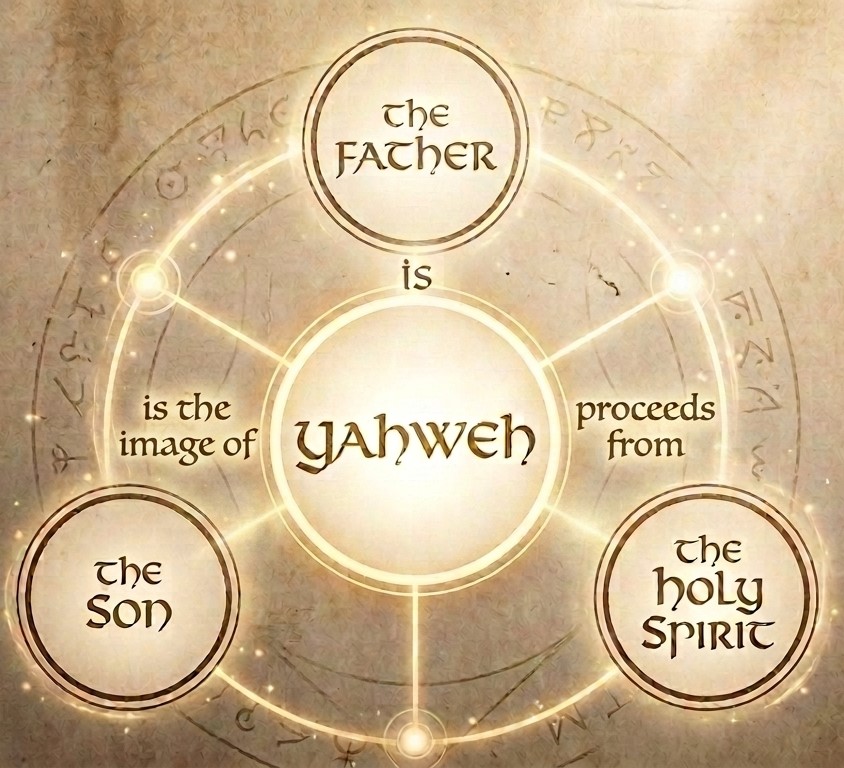
This Yahweh-centered view bridges the Old and New Testaments using strict scriptural continuity:
Yahweh’s Name: Proclaiming the Messiah as Yahweh does not create a rival to God’s glory; it directly fulfills it by revealing who God is to humanity.
Yahweh as the Exclusive Savior (Isaiah 43:11): The verse “I, even I, am Yahweh, and besides Me there is no savior” is interpreted to mean that salvation is not a delegated power, but an exclusive power that belongs to Yahweh alone. Hosea 13:4 is frequently cited in support of this exclusive claim.
The Messiah as Savior: (Colossians 1:15-17): These verses describe the Messiah as the “image of the invisible God” and the creator of all things, aligning with Isaiah 44:24, where Yahweh states He creates everything by Himself.
John 8:24 I said therefore unto you, that ye shall die in your sins: for if ye believe not that I AM (he), ye shall die in your sins (Note: the word ‘he’ is added to this and many other ‘I AM’ scriptures without warrant).
Messiah’s “I AM” declarations are most prominant in the gospel of John; Noteable references include, John 8:12, 23, 24, 28, 58,10:11,14, 11:25, 14:6, 18:5-6.
When Messiah said, “if ye believe not that ‘I AM,’ ye shall die in your sins,” a proclamation is given with the importance of understanding who He really is; salvation is through the name of Yahweh alone.
Yahweh Manifested in the Flesh as the Messiah: (1 Timothy 3:16) This verse describes the “mystery of godliness” as “Yahweh was manifest in the flesh,” aligning with the title Immanuel (“Yahweh with us”) in Isaiah 9:6 and Matthew 1:23. In John 8:58, Messiah’s statement, “Before Abraham was, I am,” is interpreted as a direct claim to be the “I AM” (Yahweh) of the Old Testament. The Judeans were very familiar with this ‘Glorious title’—and attempting to stone him—understanding this as a claim of equality with Yahweh.
The undeniable Conclusion: Even deductive reasoning would dictate that if Messiah is the Savior, then He must be Yahweh manifested in the flesh, rather than a separate, delegated entity; Yahweh clearly states He is the only Savior.
God cannot sit next to God: (Psalm 110:1)
Hebrews 10:12-13 states that the Messiah sits at the right hand of God, waiting until his enemies are made his footstool.
The Messiah, who is God, could not sit at the right hand of God – unless there are two gods. Rather, the Messiah is the right hand or power of God.
- According to 1 Corinthians 15:25, our Messiah will reign until God has put all enemies under His feet. And then, once all things are subjected to Him, He will become subject to the Father, delivering the kingdom to God.
- This premise is both impossible and contradictory. The Messiah, who is God the Father, cannot deliver the kingdom over which He reigns to God the Father (John 14:7-9; Isaiah 9:6).
Our Messiah and Savior will be revealed from heaven with His mighty angels to judge the living and the dead. He will establish His kingdom after the Great Tribulation, at the sound of the last trumpet, which rules out a pre-tribulation rapture (1 Cor 15:52). Additionally, the wicked are taken away, while the righteous are left behind.
- The reign of the Messiah (who is God) is outlined in 2 Thessalonians 1:7, 2:3, 2:8, 2 Timothy 4:1, and Revelation 19:20-21. He is not seated at God’s right hand, waiting for God to conquer His enemies.
Yahweh’s Name Removed from the Old & New Testaments
The New Testament reveals Yahweh’s person and character through the Messiah, fulfilling the promises He made in the Old Testament, and yet His name has been removed from the scriptures He inspired to be written.
The New Covenant that is given unto a spiritual Israel (Romans 8:14, 9:6, 30-33), is established through the Messiah’s sacrifice, wherein sins and iniquities are remembered no more (Hebrews 8:7-13). This fulfills the Old Covenant promises in Jeremiah 31:31-34.
Replace the title of “the Lord” in the following verses with the glorious name of “Yahweh,” and discover “Scriptural Continuity.”
Revelation 15:4 Who shall not fear thee, O Yahweh, and glorify thy name? for thou only art holy: for all nations shall come and worship before thee, for thy judgments are made manifest
Psalm 86:9 All nations whom thou hast made shall come and worship before thee, O Yahweh; and shall glorify thy name
We are commanded to worship Yahweh our God (Luke 4:8, Psalm 99:9, Exodus 34:14).
In Revelation 1:8, Alpha and Omega would be translated as the first and the last.
Yahweh, the redeemer, declared this in Isaiah 44:6, “I am the first, and I am the last, and beside me there is no God.”
The same declaration is made in Revelation 1:8, where He said: “I am first and the last, the beginning and the ending, saith Yahweh, who is, and who was, and who is to come, the Almighty.”
Revelation 4:8 And the four beasts had each of them six wings about him; and they were full of eyes within: and they rest not day and night, saying, Holy, Holy, Holy, Yahweh God Almighty, who is, and who was, and who is to come.
In Isaiah 6:3, one of these majestic beings with six wings also proclaims Holy, Holy, Holy, unto Yahweh.
According to Yahweh, there is no other Savior other than Him. He is the first and the last. In Isaiah 45:5, He said: “I am Yahweh, and there is none else, there is no God beside me.” (Isaiah 33:22, 45:5-6, 45:21, 48:12, 54:5, Revelation 1:4, 1:8, 1:17-18, 21:6-7, 22:13).
Isaiah 45:22 Look unto me, and be ye saved, all the ends of the earth, for I am Yahweh and there is none other